Chemical Reactions
Table of Contents
1. Solution Reaction
1.1. Acid Base
It is the tendency to release or absorb proton or hydroxyl group. More generally exchanging chemicals without changing the oxidation number.
In certain context, reductant and oxidant is considered as the acid and base.
Acidic chemical tends to be corrosive because the proton pulls the electron of the material causing them to react with the conjugate base.
1.2. Formal Concentration
The total compound added to the titrant per volume: \[ F := \frac{n}{V}. \]
This quantity is useful because it is a known apriori.
1.3. Fraction of Dissociation
\[ \alpha_\mathrm{X} := \frac{[\mathrm{X}]}{F} \] where \( F \) is the formal concentration of a chemical that can produce \( \mathrm{X} \).
For a monoprotic acid, assuming ideal solution,
\begin{align*} &K_\mathrm{a} = \frac{[\mathrm{H}^+] (F - [\mathrm{HA}])}{[\mathrm{HA}]}. \\ \implies &[ \mathrm{HA} ] = \frac{[\mathrm{H}^+] F}{[\mathrm{H}^+] + K_{\mathrm{a}}}. \end{align*}Therefore, the following is always the case:
\begin{align*} \alpha_{\mathrm{HA}} = \frac{[\mathrm{HA}]}{F} = \frac{[\mathrm{H}^+]}{[\mathrm{H}^+] + K_{\mathrm{a}}}, \\ \alpha_{\mathrm{A}^-} = \frac{[\mathrm{A}^-]}{F} = \frac{K_{\rm a}}{[\mathrm{H}^+] + K_{\mathrm{a}}}. \end{align*}1.4. Henderson-Hasselbalch Equation
The \( \rm pH \) of weakly acidic solution is estimated by: \[ \mathrm{pH} = \mathrm{p}K_{\mathrm{a}} + \log_{10} \frac{[\mathrm{A}^-]}{[HA]}. \]
If the activity coefficients are included, then it becomes exact.
This is useful for calculating the pH in a buffer solution.
1.5. Buffer Capacity
\[ \beta := \dv{c_{\mathrm{b}}}{\rm pH} = -\dv{c_{\mathrm{a}}}{\rm pH} \] where \( c \) is the concentration of acid or base in the buffer solution.
1.6. Titration
1.6.1. General Approach
Solve the system of nonlinear equations obtained from:
- Charge balance of the entire solution,
- Mass balance for each atom or group of atoms,
- Equilibria of pertinent reactions.
Usually simplifying assumptions are made.
- Strong titrant: complete reactions.
- Strong analyte: complete dissociation.
1.6.2. Gran Plot Equation
When strong base is used to titrate a weak acid \( \rm HA \), the equivalence volume \( V_\mathrm{e} \) of the base can be calculated without fully neutralizing the acid.
We extrapolated \( x \)-intercept of the Gran plot: \[ V_{\mathrm{b}}\cdot 10^{-\rm pH} = \frac{\gamma_{\rm HA}}{\gamma_{\rm A^-}} K_\mathrm{a}(V_\mathrm{e} - V_\mathrm{b}) \] where \( V_\mathrm{b} \) is the volume of titrant, \( K_\mathrm{a} \) is the acid dissociation constant, and \( \gamma_X \) are the activity constants.
1.6.2.1. Derivation
We assume that strong acid is all used in neutralization:
\begin{align*} [\mathrm{A}^-] &= \frac{V_\mathrm{b}F_\mathrm{b}}{V_\mathrm{b} + V_\mathrm{a}}, \\[.5em] [\mathrm{HA}] &= \frac{V_\mathrm{a}F_\mathrm{a} - V_\mathrm{b}F_\mathrm{b}}{V_\mathrm{a} + V_\mathrm{b}}\\ \end{align*}where \( F_\mathrm{a}, F_\mathrm{b} \) are the formal concentrations of acid and base. This is justified since we are not close to the equivalence point.
\( [\mathrm{H}^+] \) can be related to these concentrations by \( K_\mathrm{a} \): \[ [\mathrm{H}^+]\gamma _{\rm H^+} = K_\mathrm{a} \frac{[\mathrm{HA}]\gamma_{\rm HA}}{[\mathrm{A}^-]\gamma_{\rm A^-}}. \] This is the equation we want after noticing that:
\begin{align*} V_e &= \frac{V_\mathrm{a}F_\mathrm{a}}{F_\mathrm{b}}, \\ 10^{-\rm pH} &= [\mathrm{H}^+]\gamma_{\rm H^+}. \end{align*}1.6.3. Fraction of Titration
When titrating acid with base \[ \phi := \frac{c_\mathrm{b}V_\mathrm{b}}{c_\mathrm{a}V_\mathrm{a}}. \]
Assuming ideal solution, this can be rewritten as follows: \[ \phi = \frac{\displaystyle\alpha_{\mathrm{A}^-} - \frac{[\mathrm{H}^+] - [\mathrm{OH}^-]}{c_{\rm a}}}{\displaystyle\alpha_{\mathrm{BH}^+} + \frac{[\mathrm{H}^+] - [\mathrm{OH}^-]}{c_{\rm b}}}. \]
2. Oxidation-Reduction Reaction
It involves the change in the oxidation number, that measures how much the electron is depleted.
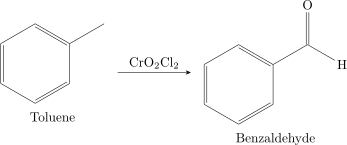
3. Étard Reaction
4. Corrosion
Chemical reaction upon contact. Typically the oxidation of metal.
It happens because the electron prefers to be attached to oxygen than metal.
5. Thermite Reaction
Lithium reduces the SiO2 into silicon metal, releasing heat.
6. Dyotropic Reactions
Two radicals exchanging their points of attachment.
It obeys the Woodward-Hoffmann rule. A complex version? of the Hückel's (aromaticity) rule.
7. SALLE
Salt-Assisted Liquid-Liquid Extraction
The salt binds strongly to the water and expels other chemicals. Easy way to separate alcohol and water - YouTube
8. Hypergolic Reaction
Spontaneous ignition upon contact with an oxidizer