Electrochemistry
Table of Contents
1. Electrochemical Cell
An electrochemical cell consists of two electrodes in contact with electrolyte. The electrode where reduction happens is called cathod, and where oxidation happens anode.
1.1. Standard Reduction Potential
- \( E^{\circleddash} \)
We use \( E \) for electrostatic potential in electrochemistry.
The electric potential of the material with respect to the standard hydrogen electrode (S.H.E.).
The reduction potential arise from the chemical potential difference between the reactant and product at each electrode. It does not affect the voltage directly, but the induced charge differential would create the voltage we are measuring here.
It is the energy released per -1 C of electron when seperated from the hydrogen and captured by the material. Large reduction potential means the potential well is deeper. It is only an affine quantity, with the hydrogen \( \rm 2H^+ + 2e^- \to H_2 \) having zero reduction potential.
1.2. Nernst Equation
When the concentrations of the reactants and products deviate from their standard state, the (equilibrium) reduction potential changes: \[ E = E^{\circleddash} - \frac{RT}{zF}\ln \frac{a_{\rm Red}}{a_{\rm Ox}} \] where \( z \) is the number of electron required for unit reduction, \( F \) is the Faraday constant (the charge per one mole of proton).
1.3. Overpotential
An half-cell shows voltage drop called overpotential \( \eta \) when current flow though it. Overpotential arises due to charge transfer and mass transfer. Charge transfer is the transfer of electron between the reactant and electrode at the surface of the electrode. Mass transfer is the transport of reactant and product through the diffusion layer that surrounds the electrode.
1.4. Concentration Polarization
When there is current flowing through the cell, the diffusion layer surrounding each electrode is formed. The concentration of the reactant decreases as you approach the electrode surface, and the reduction potential changes: \[ E = E^{\circleddash} - \frac{RT}{zF} \ln \frac{a_{s,\mathrm{Red}}}{a_{s,\mathrm{Ox}}}. \]
At cathod, the oxidated species is consumed and the reduction potential is lower. On the other hand, at anode, the reduced species is consumed and the reduction potential is higher. These deviations are called the concentration polarization.
1.5. Circuit Model
An half-cell in a full cell can be modelled with a voltage source and resistor.
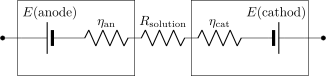
The voltage across the entire cell \( E_{\rm cell} \), when there is current \( i \) flowing through it, is given by: \[ E_{\rm cell} = (E(\mathrm{cathod}) - \eta_{\rm cat}) - (E(\mathrm{anode}) + \eta_{\rm an}) - iR_{\rm solution}. \] Overpotential and the electrolyte resistance are all parts of the internal resistance.
\( E(\rm anode) \) and \( E(\rm cathod) \) include the concentration polarization as well.
1.6. Intuition
There are two potential working simultaneously: chemical potential and electrostatic potential. The chemical potential of chemical species can be summerized into the effective chemical potential of electron.
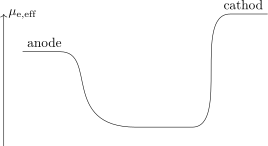
The electrostatic potential exactly copies the chemical potential, applying force in the opposite direction on the electron.
When external voltage is applied, the electrostatic potential changes, but the chemical potential changes much more slowly. For example, consider the applied voltage is larger than the equilibrium cell voltage.
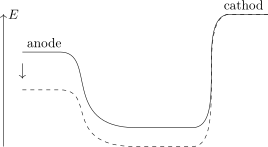
The chemical potential dominates and drives electron out of the anode into the solution, causing reduction. The reduced species increases, and the reduction potential decreases, forming a new equilibrium that matches the voltage.
2. Three-Electrode Cell
The three electrodes are: working, auxiliary (or, counter), and reference electrode. Typical three-electrode cell looks like this:
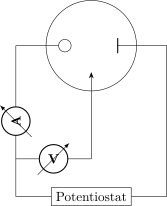
Here, the circle is the working electrode, bar is auxiliary, arrow is reference electrode.
Ideally, the counter electrode is non-polarizable, that is, the potential stays constant as the current flows.
Currrent into the working electrode is positive, and the applied voltage is the voltage at working electrode minus the voltage at the reference.
3. Voltametry
The current density is measured as a function of working electrode potential (with respect to the reference). Current density is the current per area of working electrode surface.
3.1. Rotating Disk Electrode
The working electrode rotate axially, keeping the thickness of diffusion layer constant. The half-wave potential is measured, which is proportional to the reactant concentration.
3.2. Cyclic Voltammetry
The voltage is applied in triangular wave form. The thickness of diffusion layer changes as the voltage changes.
3.3. Palography
Dropping-mercury electrode is used, where a suspended mercury droplet is used as the working electrode.